From Panic to Smart Disposal: The Impending TV Signal Switchover in Cyprus
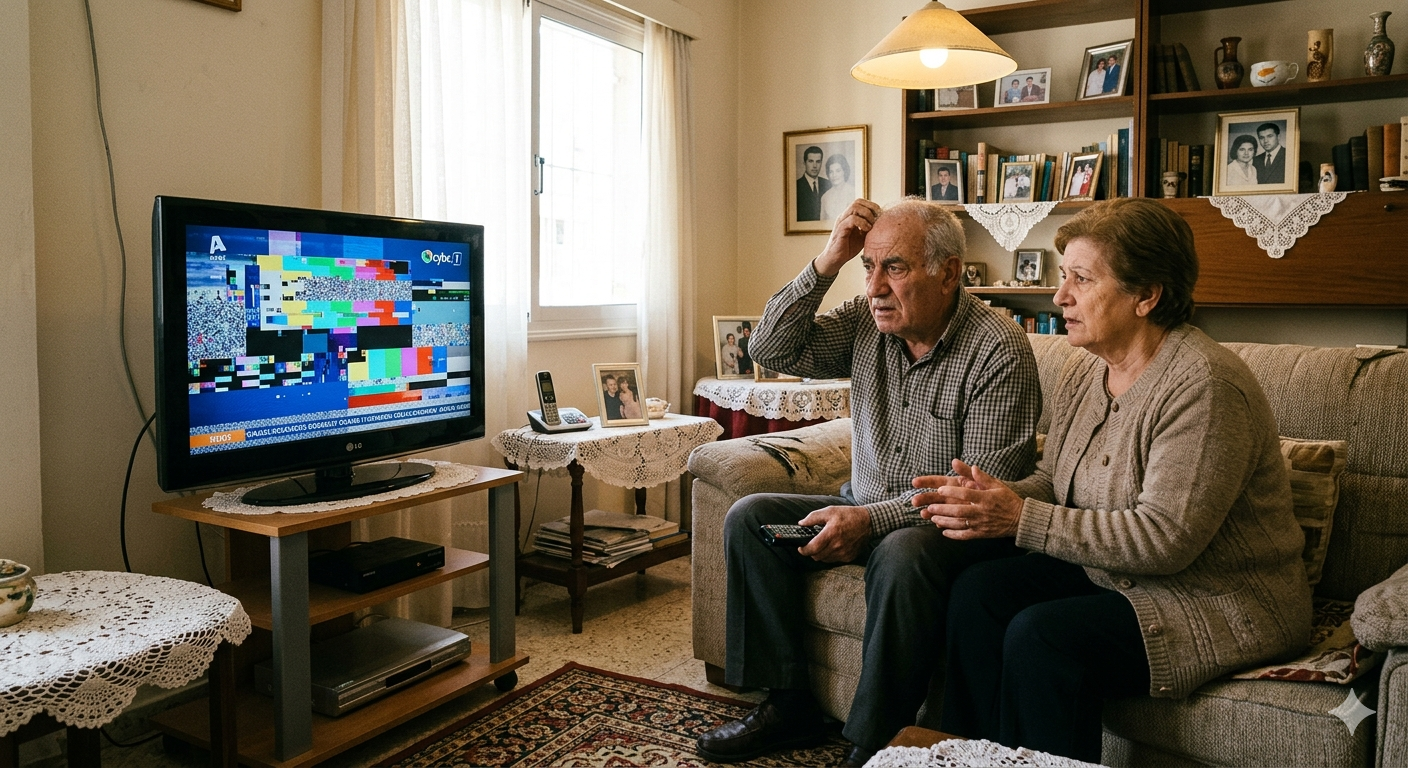
AI generated image of an elderly couple in a cozy Cyprus living room, looking bewildered as their television screen displays the heavily pixelated and fragmented signal typical of a failing digital broadcast.
"Orestis, is our TV going to stop working! What are we going to do?"
A few days ago, my parents called me in a state of absolute panic. They had caught a snippet on the local news about a massive shutdown of the television network, and to them, it sounded like their primary window to the world was about to be permanently bricked.
Personally, I don't even watch traditional TV. Like many people my age, I use my screen exclusively for Netflix, YouTube, and streaming. But for my parents and thousands of older citizens across Cyprus the thought of losing their free local channels is a genuinely stressful crisis.
If you or your relatives use a rooftop or indoor aerial (antenna) to watch free local channels like Sigma, Omega, Antenna, or Alpha, that countdown is very real. The Ministry of Research, Innovation and Digital Policy has transferred broadcasting operations from Velister to Hellas Sat, and with that transition comes an absolute mandate: Cyprus is completely phasing out the legacy DVB-T broadcasting platform and replacing it with the newer DVB-T2 standard.
The government has officially pushed the final hard cutoff deadline to July 1, 2026.
If you are a subscriber to CytaVision, Cablenet, or PrimeTel, you can ignore the noise. Your internet and cable boxes handle everything. But if you rely on traditional antennas, your TV screens are about to go entirely black unless you adapt.
Naturally, after calming my parents down, my curiosity and background in physics kicked in. I decided to dig past the tech marketing headlines and find out exactly what is going on, how much this will cost our wallets, and what happens to the mountains of old televisions that are about to become obsolete. What I found is a classic mixture of engineering progress, consumer friction, and a brilliantly progressive European environmental law that local electronics stores are desperately hoping you never find out about.
The Architecture of the Switch: Bandwidth, Codecs, and Physics
To understand why this change is mandatory, we have to look at the invisible highway of our atmosphere. Radio frequencies—the spectrum used to beam television, radio, and mobile internet through our homes—are strictly finite.
Right now, the airwaves are facing an unprecedented global "frequency crunch." Governments worldwide, including the Republic of Cyprus under EU mandates, are systematically reclaiming frequencies historically reserved for television broadcasting. Why? To sell them off to telecom giants to power our expanding 5G networks and prepare the infrastructure for the arrival of 6G.
This leaves television networks with a massive problem: they have to fit their channels into a significantly narrower slice of the airwaves.
This is where DVB-T2 (Digital Video Broadcasting — Terrestrial 2nd Generation) comes to the rescue. It is a marvel of signal efficiency, offering a 30% to 50% boost in bandwidth capacity over the old DVB-T standard.
When paired with modern video compression codecs like HEVC (H.265), which compress digital video data far more tightly than the ancient MPEG formats used by old terrestrial TV, the transmission pipeline is revolutionized. It allows broadcasters to transmit vastly more data through a much thinner pipe.
Perceptual Reality: Does It Actually Look and Sound Better?
The marketing materials promise a revolution in quality. But what will your eyes and ears actually perceive? The honest answer depends entirely on the size of your television screen and what you are watching.
1. Resolution vs. Artifacts (The End of the "Blocky" Football Match)
The old DVB-T bandwidth constraints meant that local Cypriot channels were heavily compressed, often broadcast in standard definition (SD) or low-bitrate 720p/1080i. DVB-T2 allows for a stable, nationwide rollout of pristine 1080p Full HD.
More importantly, the modern codec solves the problem of "compression artifacts." If you've ever watched an intense, fast-moving match on AEL or Omonia or an action film on free-to-air TV, you’ve likely noticed the image break up into ugly digital blocks or become wildly blurry around the players. This happens because the old codec cannot process fast movement within its strict data budget. The new codec handles fast motion gracefully, keeping the picture remarkably sharp and stable. Furthermore, digital signals suffer from a "cliff effect"—they either work flawlessly or break down entirely. DVB-T2 is significantly more robust against atmospheric interference (like heavy winter rain, dust, or physical obstructions), resulting in fewer signal drops.
2. The Sound
DVB-T2 accommodates advanced multi-channel audio codecs, such as Dolby Digital Plus. If you have a dedicated soundbar or a home cinema setup in your living room, you will notice distinct dialogue clarity and punchier audio dynamics during films or major live broadcasts. If you are listening through basic, built-in TV speakers, however, the audio improvement will be negligible.
3. The Great Screen Size Equation
This is where the law of optical physics takes over. Can the human eye actually tell the difference?
On a 40-inch (or larger) living room TV: The change will be highly significant. Moving from compressed SD/720p to uncompressed, high-bitrate 1080p on a large canvas makes facial details, text, and background landscapes look night-and-day sharper.
On a 24-inch or 28-inch kitchen/bedroom TV: The perceptual difference is minimal. At normal viewing distances (e.g., looking at a kitchen counter screen while cooking), the human eye physically cannot resolve the difference between 720p and 1080p on a panel that small. The physical pixel density naturally masks lower signal quality anyway. It will look slightly cleaner, but it won't feel like a visual revolution.
The Solutions: Defeating the "Two-Remote Nightmare"
If your parents or relatives have a modern television bought around 2017 or later, it likely already has a DVB-T2 tuner built right inside. They don’t need to spend a single cent. They simply open their TV settings menu, run an automatic channel rescan (retune), and let it map to the new Hellas Sat frequencies.
But what if they own an older TV (pre-2017) that works perfectly fine but lacks a DVB-T2 tuner?
The traditional solution has been the external decoder box. But let’s be entirely practical: decoders are historically a massive nuisance. They introduce the dreaded "two-remote nightmare"—one remote to turn on the TV and switch to the correct HDMI input, and a second remote to change the channels on the box. It is a clunky, frustrating user experience that drives many older people to give up and throw away a perfectly functional television just to buy a new one with a single remote.
Thankfully, hardware design has evolved. If you need to upgrade an older screen, you have two elegant, low-cost alternatives that entirely bypass the hassle:
The "2-in-1 Learning Remote" Decoders: Many modern DVB-T2 boxes sold in local Cyprus shops (from brands like OSIO and Sonora) now explicitly include a programmable learning remote. By placing the old TV remote head-to-head with the new remote for a few seconds, the new remote "learns" the TV's power, volume, and input keys. You can chuck the old remote in a drawer forever; the single new remote handles everything.
The Hidden HDMI Stick: Instead of a box cluttering the counter, you can purchase a tiny DVB-T2 receiver stick about the size of a USB flash drive. It plugs directly into an empty HDMI port on the back of the TV out of sight. It draws its power from the TV's own USB port (turning on and off automatically with the screen) and connects directly to the existing rooftop aerial cable. A tiny infrared "eye" on a thin wire sticks to the front frame of the TV to catch the remote signal.
The Pragmatic Catch: Of course, even a learning remote means trading your premium, ergonomically optimized original remote (like a sleek Samsung or LG clicker) for a generic, plasticky alternative with mushy buttons. If you refuse to compromise on muscle memory, look for a DVB-T2 receiver that explicitly supports HDMI-CEC (often branded as Samsung Anynet+ or LG SimpLink). This brilliant protocol allows commands to travel directly through the HDMI cable, meaning you can hide the cheap decoder remote in a drawer entirely and continue using your high-quality, familiar TV remote to change the channels.
Crunching the Numbers: The Scale of the Cost and the E-Waste
Why can't the broadcasters simply transmit both DVB-T and DVB-T2 signals forever so nobody gets left behind? Because running a dual nationwide transmission ("simulcast") requires double the radio spectrum, doubles the astronomical electricity bills of our broadcast towers on Mount Olympus, and prevents the state from freeing up the frequencies required for mobile broadband. The dual broadcast period currently active is a courtesy; on July 1, 2026, the old lane closes permanently.
Let’s look at some back-of-the-envelope calculations to understand the socio-economic and environmental footprint of this transition in Cyprus.
The Consumer Split
According to Eurostat and Cyprus Statistical Service demographic data, there are roughly 390,000 households in the Republic. Roughly 25% to 30% rely entirely on free-to-air terrestrial antennas, meaning approximately 110,000 households are directly affected.
Given an average of 2.2 televisions per home, and accounting for the fact that roughly 60% of active TVs are modern enough to be naturally compatible, we can realistically estimate that 100,000 to 120,000 older televisions across Cyprus will lose their signal on cutoff day.
How will Cypriot consumers respond? Based on historical data from similar European digital switchovers, we can project a behavioral split:
The Practical Route (65%): ~71,500 TVs will be retrofitted with a €25–€35 HDMI stick or decoder box.
The Upgrade Route (25%): ~27,500 TVs will be retired entirely in favor of a brand-new television.
The Disconnect Route (10%): ~11,000 secondary, rarely-used TVs will simply be unplugged and abandoned.
The Cost to Your Wallet
For a typical Cypriot household owning 3 older televisions (e.g., living room, kitchen, bedroom) that require attention, the financial out-of-pocket impact varies wildly based on consumer awareness:
Scenario A (Pure Adaptor Route): 3 HDMI Sticks/Decoders $\times$ €30 = ~€90 total
Scenario B (The Pragmatic Upgrade): 1 New Living Room TV (€400) + 2 Decoders (€60) = ~€460 total
Scenario C (The Electronic Shopping Spree): Replacing all three televisions with modern screens = ~€900 to €1,200+
The 460-Ton Environmental Menace
If the behavioral projections hold true, roughly 38,500 older televisions will be permanently taken out of service across our island over this transition period.
The average older flat-screen LCD or Plasma TV weighs roughly 12 kilograms. If citizens simply chuck these into standard green garbage bins, skip bins, or illegally dump them in our beautiful countryside valleys, Cyprus will face over 460 metric tons of toxic electronic waste entering its landfills.
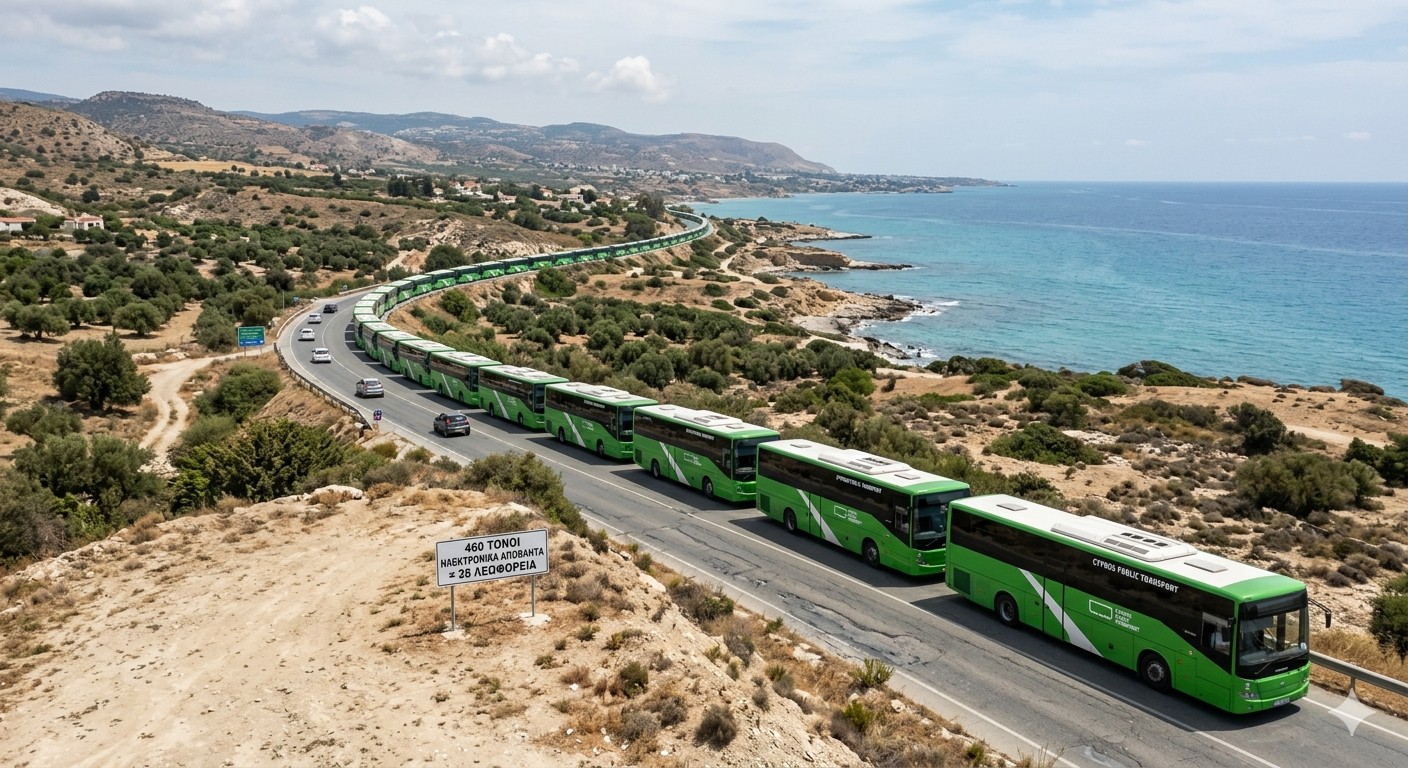
To help you visualise this, 460 metric tons is almost the same as 38 buses. Imagine 38 buses worth of TVs in a line, stretching along 450 meters of road.
Televisions are not simple pieces of plastic. They are packed with hazardous materials including lead, cadmium, mercury, and brominated flame retardants. If left to rot in landfills, these heavy metals will inevitably leach into the ground, permanently threatening Cyprus’s highly fragile groundwater tables. Furthermore, discarding them represents a massive loss of valuable commodities; embedded within those 460 tons are thousands of euros worth of high-grade copper, silver, aluminum, and gold that belong in a circular economy, not a dump.
The Secret Weapon: The Hidden Return-and-Recycle Law
This brings me to the most important piece of practical leverage you have as a consumer and a citizen.
Most people in Cyprus are well aware that if they buy a new refrigerator or washing machine, the delivery team will usually haul the old, broken one away. Yet, for some reason, the general public completely ignores this concept when it comes to smaller electronics like televisions, laptops, and monitors.
If you or your relatives decide to take the "Upgrade Route" and buy a new television to prepare for the DVB-T2 switchover, you are legally entitled to hand your old TV over to the retailer for free recycling.
This isn’t a voluntary courtesy program run by the shops; it is a rigid legal obligation backed by powerful legislation.
The Exact Legal References
The European Directive: Under Article 5(2)(b) of the European Directive 2012/19/EU on Waste Electrical and Electronic Equipment (WEEE), member states must ensure that distributors provide a 1-for-1 take-back system free of charge, provided the returned equipment is of an equivalent type and fulfilled the same functions as the supplied equipment.
The Cypriot Harmonization: This European law was directly woven into our national framework via The Waste Management Law of 2011 (L. 185(I)/2011) and governed by Regulatory Administrative Act (K.D.P.) 668/2004, which officially empowers WEEE Cyprus as the compliance scheme. Under these national laws, electronics retailers are legally categorized as "distributors/producers" and must facilitate this waste stream.
The Two Rules Every Consumer Must Know:
The 1-for-1 Mandate (All Retailers): If you purchase a new TV from any shop in Cyprus (whether online or brick-and-mortar), that business is legally mandated to accept your old television for recycling completely free of charge. If you pay for home delivery of your new screen, the delivery drivers are legally required to load your old TV onto their truck and take it away if requested.
The 400-Square-Meter Rule (Large Retailers): Under the expanded WEEE framework, any major electronics store with a physical retail space exceeding 400 square meters (which includes major local chains like Stephanis, Public, Electroline, Superhome Center, etc.) is legally required to accept very small e-waste (items under 25cm, like old cables, remote controls, or phones) completely free of charge, with absolutely no obligation for you to buy anything new.
Why haven't you seen this plastered on the front page of store flyers? Because storing, cataloging, and transporting bulk e-waste to WEEE consolidation hubs is a logistical headache and an operational cost for retailers.
It’s worth noting that WEEE Cyprus officially collected 234 tonnes of TVs in 2023 alone. With the impending 2026 switchover, we are about to see a massive tidal wave of e-waste that will dwarf that number.
The Final Verdict
The DVB-T2 transition is an inevitable step toward an interconnected, 5G-enabled future. It gives us cleaner airwaves and crisp, artifact-free viewing on our main living room displays.
But progress should not come at the cost of our families' wallets or our environment. If you have older relatives panic-calling you about their screens going black, don't let them rush out to buy an expensive new TV they don't need. A simple €25–€35 DVB-T2 learning remote box or a hidden HDMI stick will solve their problem completely while maintaining the exact single-remote simplicity they are used to.
And if an upgrade is truly necessary, hold our retailers accountable to the law of the land. Make the store take the old television back, keep it out of our countryside, and let the official channels handle the rest.
Official Support
If you need official assistance navigating the transition, troubleshooting your signal, or checking the hardware compatibility of a specific TV model, please contact the designated government and technical support hotlines directly:
Hellas Sat Transition Hotline:22 861 400
WEEE Cyprus Recycling Information: 7000 9333
Green Points (Πράσινα Σημεία): Contact your local municipality or community council for the nearest designated electronics drop-off location.
Why Isn't Anyone Talking About This?
Unfortunately, this is true.
Look through the official information channels, and you will find an absolute wall of silence regarding this looming 460-tonne electronic waste problem. If you check the official Hellas Sat transition portal, their mandate stops strictly at the signal; they explain how to rescan or point you toward buying a new decoder unit, completely ignoring where the old tech ends up. If you look at WEEE Cyprus, they remain in a standard, business-as-usual collection cycle rather than sounding an alarm about a massive, synchronized television dump hitting the island.
How did such a massive blind spot happen? In my opinion, it is a perfect storm of bureaucratic disconnection, economic incentives, and a very timely political distraction:
The Ministry Silo Effect: In the Cypriot civil service, the left hand rarely coordinates with the right. The technical switchover was managed entirely by the Department of Electronic Communications under the Deputy Ministry of Research, Innovation and Digital Policy. Their objective is spectrum management and infrastructure. Because they operate in a completely separate silo from the Department of Environment (under the Ministry of Agriculture), the environmental fallout of a synchronized hardware obsolescence was never put on the agenda.
The Profit Incentive: Let's be entirely candid about state and retail economics—governments rarely fund public awareness campaigns that actively discourage immediate consumer spending. When thousands of citizens rush out to electronics stores to buy €30 decoders or €400 televisions, it generates an immediate spike in VAT revenue for the state and a massive windfall for retail giants. Prominently advertising a law that forces retailers to absorb the logistical cost of hauling away heavy, toxic e-waste runs completely counter to short-term retail interests.
The Parliamentary Election Distraction: Above all, the timing of this cutoff has allowed the issue to slide entirely under the radar. The media airwaves, the Press and Information Office (PIO), and public attention are completely consumed by the May 2026 legislative elections. With political parties trading blows, candidate preferences dominating the news cycle, and the public hyper-focused on parliamentary seat projections, a 460-tonne environmental bottleneck simply isn't loud enough to cut through the noise.
The official entities are managing the transition, the retailers are collecting the profits, and the politicians are chasing votes. It is up to us as informed consumers to protect our wallets, safeguard our relatives from unnecessary panic, and hold retailers accountable to the recycling laws of the land.
References:
Directive 2012/19/EU of the European Parliament and of the Council on waste electrical and electronic equipment (WEEE).
The Cyprus Waste Management Law of 2011 (L. 185(I)/2011), Republic of Cyprus.
WEEE Cyprus Collective Compliance Scheme (Official Guidelines & Retailer Obligations).
Deputy Ministry of Research, Innovation and Digital Policy – Technical Announcements on the DVB-T2 Terrestrial Television Transition (2024-2026).