Why I went back to school for an MBA, despite already having a PhD

On lifelong learning, the anti-MBA hype, and why business education matters in a world of science, technology and innovation.
There is something slightly peculiar about going back to university when you've already spent much of your adult life studying, researching, publishing and working at the frontiers of science and technology.
People tend to assume that, at some point, you should be done with formal education. You've earned your qualifications, established your expertise, built your career. Surely, there comes a time when you can put the textbooks away and get on with applying everything you've learned.
Apparently, I hadn't received that memo.
One of the first questions I was asked during my MBA dissertation viva was rather unexpected.
"Why did you decide to do an MBA?"
Not a question about my research methodology, my findings or the conclusions of my dissertation. But something more fundamental. Why was I there in the first place?
It was a fair question.
I already had a PhD in mathematics, scientific publications, patents, books, and an established career in research, emerging technologies and R&D management. I had spent years working on innovation and technology commercialisation, helping turn ideas and scientific discoveries into practical applications.
And yet, here I was, having voluntarily spent three and a half years pursuing an online, part-time MBA at the University of Nicosia, specialising in marketing.
Three and a half years of evenings, weekends, business trips and holidays interrupted by assignments, textbooks and deadlines.
All for another degree?
The obvious question was whether I really needed an MBA.
But I think there's a more interesting question hiding underneath it.
At what point in our professional lives do we decide that we have learned enough?
It's a curious paradox. We live in a world where knowledge is expanding at an extraordinary pace, technologies are transforming entire industries, and the skills required to succeed are constantly changing. We regularly celebrate adaptability, curiosity and lifelong learning.
Yet when someone with an established career decides to return to formal education, the reaction is often one of surprise.
Why would you do that? What more do you need to learn?
Perhaps we've come to think of education as something that prepares us for our careers, rather than something that should accompany us throughout them.
Or perhaps we've confused becoming an expert in something with becoming sufficiently knowledgeable about everything else.
I recently completed my MBA with distinction. And while I'm certainly pleased with the result, looking back, I find myself thinking less about the qualification and more about what motivated me to embark on the journey in the first place.
Because the answer to that viva question, as it turns out, says something about how we understand expertise, education and the value of occasionally becoming a beginner again.

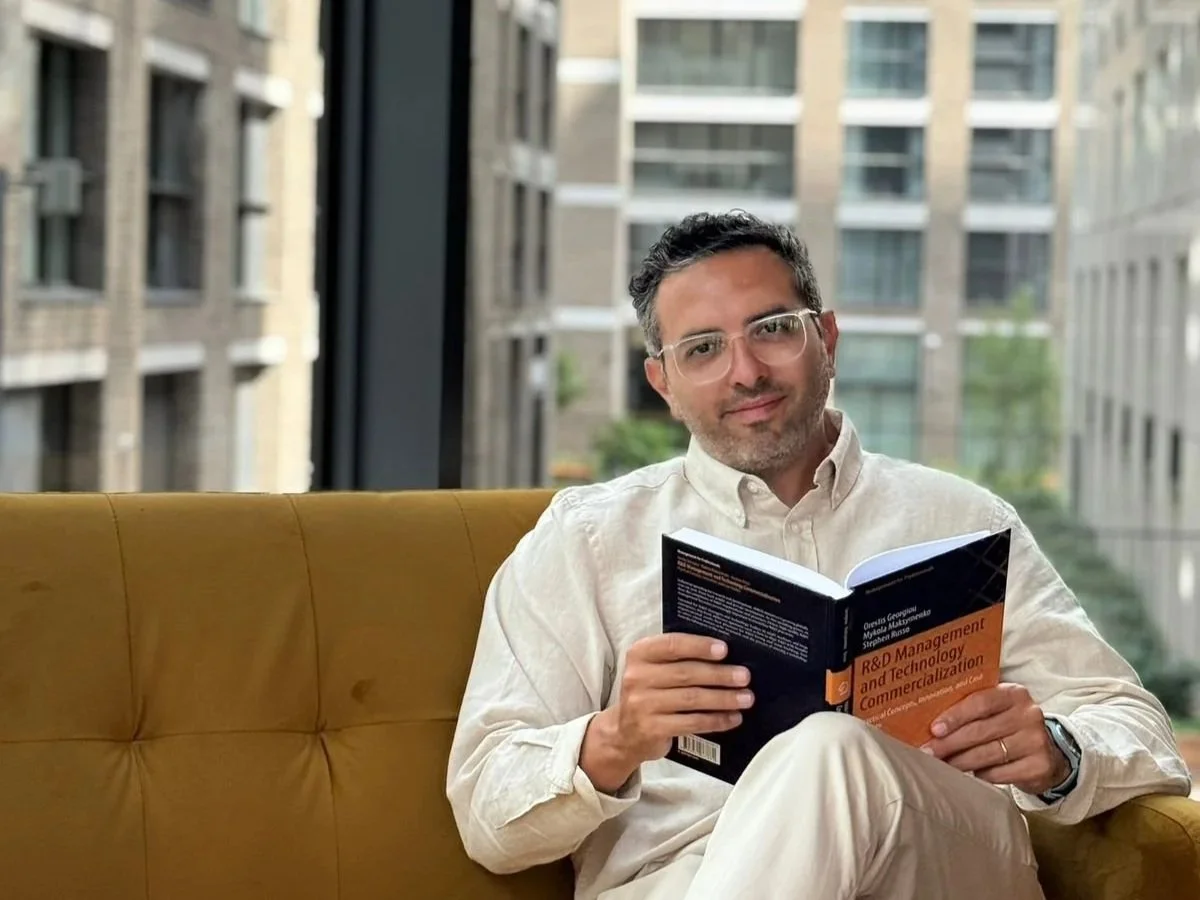
Photo Credit: George Stavrinos
Why go back to school when you're already learning every day?
I have been fortunate to spend much of my professional life working in fields where learning is practically a job requirement.
Research, mathematics, emerging technologies, R&D and innovation management are constantly evolving. New discoveries challenge established theories, technologies become obsolete, industries transform, and entirely new fields emerge. If you stop learning, you quickly become irrelevant.
And yet, there's a difference between learning continuously through your work and deliberately committing yourself to a structured programme of study in an unfamiliar discipline.

The former tends to be driven by immediate problems, professional responsibilities and the demands of your environment. The latter forces you to confront subjects you might not otherwise explore, question assumptions you didn't know you held, and engage with ideas developed by people who approach the world very differently from you.
A PhD teaches you how to investigate questions deeply, develop original research, challenge established knowledge and become an expert in a particular field.
An MBA is almost the opposite in some respects. It exposes you to an interconnected landscape of disciplines: economics, strategy, finance, marketing, operations, organisational behaviour and leadership. Rather than taking you deeper into a single subject, it challenges you to understand how multiple dimensions of an organisation interact.
Having spent years working on R&D management and technology commercialisation, and even writing a book on the subject, I was increasingly conscious of how scientific excellence, technological innovation and commercial success depend on capabilities that extend well beyond the technical domain.
I wanted to understand more of that wider picture.
But there was another reason, perhaps a more personal one. I wanted to challenge myself intellectually, outside the comfort of my existing expertise.
And I was prepared to go back to being a student to do it.
Isn't the MBA dead?
If you spend any time on social media, you would be forgiven for thinking that business schools have become obsolete.
There is no shortage of successful entrepreneurs, business influencers and self-appointed gurus declaring that MBAs are useless, that business schools teach outdated theories, or that they would never hire someone with an MBA because formal education somehow limits creativity and entrepreneurial thinking.
Meanwhile, we are surrounded by advertisements for three-day "mini-MBAs", intensive entrepreneurship bootcamps, business coaching programmes and courses promising to take you from zero to your first million.
And now, of course, there is AI.
Why spend years studying business when an AI assistant can draft your business plan, develop a marketing strategy, analyse competitors, generate financial projections and even help you build an entire digital business in a matter of hours?
There is some truth behind these arguments. Business schools are not immune to criticism. Degrees can be expensive, educational quality varies, and plenty of successful entrepreneurs have built remarkable businesses without ever attending university.
Nor does holding an MBA automatically make someone a good manager, an effective leader or a successful entrepreneur.
But I think much of the anti-MBA narrative misses a fundamental distinction.
There is a difference between knowing how to perform a task and understanding the principles that underpin it.
We wouldn't seriously suggest that because mathematical software can solve complex equations, studying mathematics is no longer necessary. Or that because AI can generate computer code, understanding computer science has become irrelevant.
Why, then, should we apply a different standard to business?
An AI tool might produce an impressive-looking marketing strategy. But does that mean you understand market segmentation, customer behaviour, competitive positioning or the assumptions underlying the proposed strategy?
It might generate financial projections, but can you evaluate whether the underlying business model is viable?
And perhaps most importantly, how do you know whether you have even asked the right questions?
A short course can be immensely useful for developing specific skills. Experience, mentorship and practical entrepreneurship are invaluable. AI is an extraordinary tool that I use and appreciate.
But none of these necessarily replaces the value of a coherent, structured body of knowledge.
The real value of education is not simply knowing the answers. It is developing the intellectual foundations to understand the questions, evaluate the answers and recognise what you don't know.
When you discover that your problems are already in the textbooks
One of the most interesting things about studying business after accumulating professional experience is the ability to connect theory with problems you've already encountered.
Imagine an entrepreneur who has spent years building a company.
They have struggled with growth, hiring, delegation, resource allocation, competitive pressures, customer acquisition and difficult strategic decisions. Along the way, they have learned through trial and error, often at considerable personal and financial cost.
Then they encounter a management framework that describes precisely the challenge they've been facing.
Suddenly, the problem has a name. There is a theoretical explanation, a body of empirical research, and perhaps several established approaches to addressing it.
What felt like an entirely unique challenge turns out to be something that researchers and practitioners have been studying for decades.
I find something particularly satisfying about this connection between experience and established knowledge.
It doesn't mean the textbook has all the answers. Real-world problems are rarely as neat as academic models suggest. Context matters, organisations are complex, and people don't always behave rationally.
But theory offers frameworks for understanding problems that might otherwise appear chaotic.
Of course, the relationship works in both directions. Someone entering an MBA straight from university may struggle to appreciate why certain management theories matter. Someone with years of professional experience may recognise their relevance almost immediately.
Theory without practice risks becoming abstract. Practice without theory risks repeatedly reinventing the wheel.
The opportunity lies in bringing the two together.
And I think this observation extends far beyond business education.
Scientific excellence is not the same as real-world impact
This brings me to something particularly relevant to my professional background.
Over the past couple of decades, expectations surrounding scientific research have changed considerably.
Universities, research institutions and funding agencies increasingly emphasise not only the generation of new knowledge but also its translation into economic, technological, environmental and societal benefits.
Nowhere is this more evident than in the European research funding ecosystem.
Consider Horizon Europe, the European Union's major research and innovation funding programme. Most of its collaborative research and innovation calls evaluate proposals against three broad criteria: excellence, impact, and the quality of implementation.
The European Research Council (ERC) stands apart in an important respect. Its frontier research grants are evaluated on scientific excellence alone, recognising the fundamental importance of curiosity-driven, investigator-led research.
But across much of the wider funding landscape, producing excellent science is only part of the challenge. Researchers are increasingly expected to explain who might benefit from their discoveries, how those benefits might be realised, and what pathways could turn research outcomes into practical change.
And this is where things become complicated.
A scientist might spend decades developing extraordinary expertise in a highly specialised discipline. They might be exceptionally good at identifying research questions, designing experiments, developing new theories and producing rigorous scientific results.
But how well equipped are they to evaluate market opportunities, understand customers, identify competitive advantages, develop commercialisation strategies, navigate regulatory environments, manage intellectual property or build sustainable business models?
These are different disciplines, with their own accumulated knowledge, theories, methodologies and professional expertise.
And yet, we increasingly expect scientists to understand and navigate all of them.
Having worked extensively in research, R&D management and technology commercialisation, I have come to appreciate just how difficult this transition can be.
The journey from scientific discovery to meaningful societal or economic impact is rarely straightforward. It involves far more than demonstrating that a technology works.
It requires understanding where a genuine need exists, how that need might evolve, what competing solutions are available, how a technology could be developed and deployed, and whether the resources, partnerships and organisational capabilities exist to sustain the journey.
Timing, market dynamics, policy, regulation and geopolitics can all influence whether a promising innovation succeeds or fails.
And yes, luck often plays a part.

A recent MIT story illustrates this beautifully.
In 2017, a group of MIT students developed a prototype wearable device that used mechanical vibrations to help reduce hand tremors. What began as a student project eventually became Encora Therapeutics. Nine years, numerous hardware iterations, clinical trials and substantial entrepreneurial effort later, the company received FDA clearance in February 2026 for a device intended to help adults with essential tremor.
Along the way, the team even reconsidered its original focus on Parkinson's disease after identifying a different unmet clinical need.
Think about what had to happen between that initial prototype and the eventual regulatory clearance.
There was undoubtedly technical ingenuity, research, experimentation and engineering. But there was also a long and difficult journey involving clinical validation, strategic decisions, fundraising, regulatory compliance, organisational development and preparation for commercialisation.
And the journey doesn't end with regulatory clearance. Manufacturing, distribution, reimbursement and market adoption present challenges of their own.
This is what translating research into impact actually looks like.
Of course, not every scientific discovery should become a company or a commercial product. Fundamental research has immense value even when its applications are unknown, distant or entirely unexpected.
Nor am I suggesting that every scientist needs an MBA.
But if we are serious about turning more scientific discoveries into innovations that benefit society, then we need to recognise that scientific excellence and business competence are complementary, not interchangeable, capabilities.
For me, this was one of the strongest reasons to broaden my education beyond the scientific and technical disciplines in which I had built my career.
Three and a half years of being a student again
Of course, recognising the value of further education and actually committing to it are two very different things.
When I enrolled, I knew I was taking on a significant commitment.
A part-time, online MBA might sound convenient. There are no regular journeys to campus, and much of the learning can be organised around existing professional responsibilities.
But that flexibility comes with a price: you have to create the time yourself.
For three and a half years, studying became part of my routine.
Evenings after work. Weekends. Time spent travelling. Days when I was technically on holiday from my day job but still had coursework, reading or dissertation work to complete.
There were deadlines to meet, assignments to prepare, examinations and assessments to navigate, and the persistent challenge of balancing academic demands against an already busy professional life.
And unlike my earlier university years, studying was no longer my primary occupation. It was something I had voluntarily added to everything else.
There is also something humbling about returning to formal education after many years in professional life.
In your career, you gradually become accustomed to operating within areas where you have accumulated expertise and experience. You develop confidence in your judgement and your ability to solve problems.
Then you find yourself studying unfamiliar subjects, working through theoretical concepts, preparing assignments and having your understanding assessed against academic criteria.
You become a beginner again.
I think that's healthy.
It reminds you that expertise is contextual, that there are many different ways of understanding the world, and that professional experience does not exempt you from having to learn the fundamentals of another discipline.
And perhaps that's one of the overlooked benefits of continuing education: the discipline and intellectual humility involved in putting yourself back into a learning environment.
So, was it worth it?
Inevitably, the value of an MBA is often discussed in financial terms.
Will it lead to a promotion? A higher salary? A better job? A stronger professional network? A successful business?
These are reasonable questions, particularly for people making a significant financial investment in their education.
But they weren't the primary measures by which I wanted to judge my own experience.
I wasn't looking for an MBA to establish my professional credentials. I already had a career I valued and an academic background that had served me well.
What I wanted was to broaden my perspective.
To understand organisations, markets and management through a more systematic lens. To connect the scientific and technological dimensions of innovation with the commercial, organisational and human factors that ultimately influence its success.
And, through my specialisation in marketing, to think more deeply about something that can sometimes receive insufficient attention in technology-driven organisations: the difference between what a technology is capable of doing and the value it actually creates for the people and organisations expected to use it.
The distinction matters.
A technology can be scientifically fascinating, technically sophisticated and genuinely novel, yet still struggle to find a viable application or market.
Conversely, understanding a problem, a customer or an unmet need can fundamentally change how we approach the development of technology in the first place.
These perspectives are not mutually exclusive. They enrich one another.
Did the MBA make me an expert in every aspect of business? Of course not.
Did it provide a structured foundation for understanding areas I previously encountered mainly through professional experience? I believe so.
And did the journey itself, with all the demands it placed on my time and energy, have value beyond the knowledge acquired?
Absolutely.
The value of becoming a beginner again
We live in an extraordinary time for learning. Information has never been more accessible, and AI can now provide answers to questions that once required hours and days of research. But access to information is not the same as knowledge, and knowledge is not quite the same as understanding.
That takes time, effort, curiosity, and a willingness to challenge what we think we already know.
I've been fortunate to build a career in which I effectively get paid to learn. Research, innovation and emerging technologies demand it. Why I decided to pursue a PhD in mathematics in the first place is perhaps a story for another day.
The MBA was, in some ways, a continuation of that journey. A deliberate decision to explore a different body of knowledge, one that I increasingly recognised as essential to the work I do.

And now comes the interesting part.
Putting that knowledge to work.
Whether through SONATA, the EIC Transition project I'm coordinating to bring acoustic levitation technology closer to commercial application, my book on R&D management and its upcoming companion course, or Orestify, my consultancy helping startups and innovators secure funding to develop their ideas, I have no shortage of opportunities to put what I've learned into practice. And I'm sure there will be others I haven't yet imagined.
Not everyone needs an MBA. Not everyone needs another degree. But I believe there is enormous value in deliberately investing in knowledge beyond the immediate demands of our careers, even when we cannot predict precisely where that knowledge might lead us.
Which brings me back to that question from my viva.
"Why did you decide to do an MBA?"
Perhaps the more interesting question is what I'll do with it.
After all, education is not something we complete. It's something we put to work.