
Cyprus AI Vision for 2032: A Reality Check
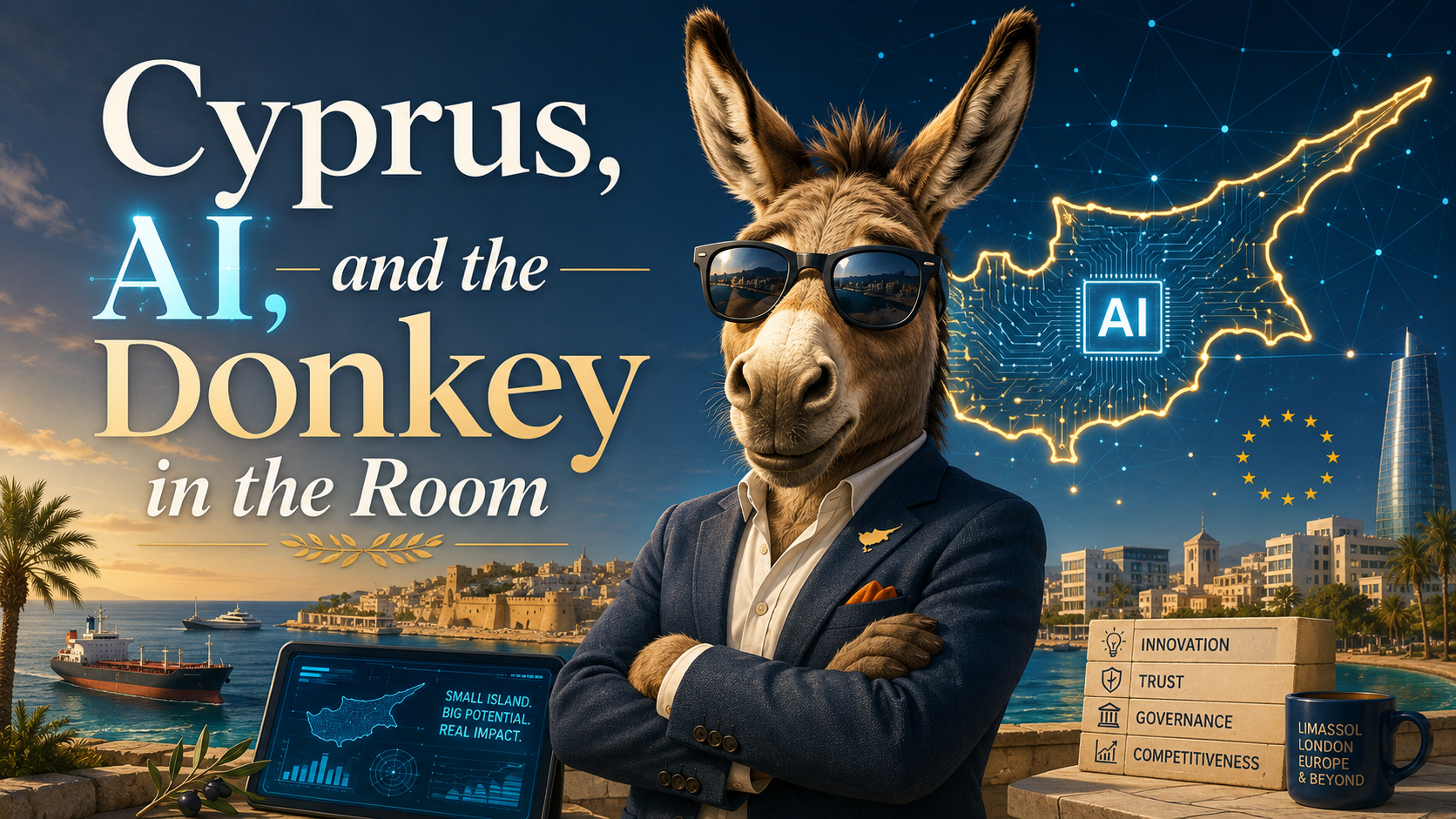
Donkeys are very intelligent animals with strong problem-solving skills, excellent memories, and a cautious nature. What people often call "stubbornness" is actually a smart survival instinct.
Cyprus Wants to Become an AI Hub by 2032.
But What Does That Actually Mean?
As someone who has spent much of his career moving between research, emerging technologies, R&D management and commercialisation, I am naturally excited by this. AI is already changing how we write, analyse information, develop software, conduct research and run organisations. Countries that learn to use it well could become more productive, attract new investment and improve how government operates.
But “becoming an AI hub” is also the kind of phrase that can mean almost anything.
Does it mean attracting international technology companies? Producing local AI products? Using AI across government? Training more specialists? Building data centres? Creating a strong regulatory environment?
The answer appears to be some combination of all of the above.
Cyprus’s proposed National AI Strategy 2032 sets out ambitions around productivity, public services, skills, infrastructure, research, trust and international cooperation. It was prepared by an 11-member National AI Taskforce bringing together government, business, academia and research, and has now entered public consultation.
In my opinion, the direction is sensible and the ambition is welcome. The more important question is how it becomes real.
First, Cyprus Is Not Acting Alone
Cyprus’s strategy sits within a much larger European effort to shape how AI is developed and used.
The most visible part of this effort is the EU AI Act. Its basic idea is straightforward: not every AI system creates the same level of risk.
An AI tool recommending music or helping someone rewrite an email should not be regulated in the same way as a system used to assess job applicants, determine access to credit or support medical decisions.
The EU therefore separates AI applications into four broad levels of risk. The strictest controls apply to prohibited or high-risk uses, while lower-risk systems are generally left alone or face limited transparency obligations.
At the same time, Europe is investing in computing infrastructure, AI Factories, research, skills and business adoption. This is important because regulation alone will not create a competitive AI economy. The EU now has 19 AI Factories and 13 associated Antennas intended to give researchers, startups and SMEs access to advanced computing resources.
Europe is trying to achieve two things at once:
«Encourage companies and governments to adopt AI, while ensuring that people can trust the systems being introduced.»
That balance is difficult. Rules that are too weak may expose citizens and businesses to harm. Rules that are too burdensome may make it harder for smaller firms to innovate and could unintentionally strengthen the largest technology companies—the only ones able to absorb substantial compliance costs.
Cyprus will have to operate within this European framework. We will not be writing the rules from scratch, but we will be responsible for applying them intelligently.
Why This Matters Especially to Cyprus
Cyprus is not a large manufacturing economy. It is overwhelmingly a service economy, with a considerable share of its output concentrated in activities that involve information, analysis, communication and professional judgement—the very tasks AI is becoming increasingly capable of supporting.
According to the national Statistical Service, information and communication generated 12.5% of Cyprus’s gross value added in 2025. Professional, scientific and technical activities generated another 6.7%, while financial and insurance activities contributed 9.2%. Together, these three broad categories accounted for more than 28% of gross value added. Professional, scientific and technical activities also employed approximately 8.1% of the workforce in 2024.
Not every job in these sectors will be automated, of course. But a large part of their value comes from processing documents, interpreting rules, searching for information, producing analysis and communicating conclusions.
This makes Cyprus unusually exposed to both the opportunities and the disruption created by AI.
The IMF has estimated that around 60% of employment in advanced economies is exposed to AI. Roughly half of that exposed work may benefit through higher productivity, while the other half faces some risk of displacement. The European Central Bank also estimates that, depending on the speed of adoption, AI could add approximately 0.2 to 0.4 percentage points to annual productivity growth over the coming decade.
(These are estimates rather than predictions. Nobody yet knows exactly how many jobs will be created, transformed or lost.)
But they demonstrate the scale of what is coming.
The Strongest Part of the Cyprus Vision
For me, the most promising part of the strategy is the ambition to become a trusted AI jurisdiction.
Cyprus is unlikely to compete directly with the United States, China, France or the United Kingdom in building the world’s largest AI models. We do not have the same research budgets, computing capacity or depth of investment.
That does not mean Cyprus has no role.
The country already has strong capabilities in areas such as professional services, shipping, financial services, compliance, cybersecurity, research and international business.
These sectors will increasingly need answers to questions such as:
- Is an AI system safe and legally compliant?
- Is sensitive data being handled correctly?
- Can an important decision be reviewed by a person?
- Can a company explain and document how its system works?
- Is the technology sufficiently reliable for use in a regulated industry?
As the EU AI Act is implemented, demand for AI assurance, governance, testing and compliance will grow.
Cyprus could build on its existing professional-services economy by developing the technical expertise required to support these activities. Lawyers, auditors, cybersecurity professionals, engineers and data scientists will need to work together.
In my opinion, that is a much more credible opportunity than trying to build a Cypriot equivalent of OpenAI.
Responsible Creation—and Responsible Destruction
There is another aspect of responsible AI that I believe receives too little attention.
I recently completed my MBA research on readiness for creative destruction: the process through which new technologies and business models create economic value while making older products, skills and organisations less competitive or obsolete.
AI is likely to accelerate both sides of that process.
The creative side is easy to celebrate. New companies will emerge. Scientific research may accelerate. Small teams will be able to do things that previously required entire departments. Existing businesses may become substantially more productive.
The destructive side is less comfortable. Some roles will shrink. Certain skills will lose market value. Businesses that fail to adapt may disappear. Employees who have spent years developing expertise in a particular workflow may discover that parts of it can suddenly be performed in seconds.
When we talk about responsible AI, we therefore need to consider both responsible creation and responsible destruction.
Responsible creation means developing safe, useful and trustworthy systems.
Responsible destruction means helping workers, companies and institutions adapt when those systems alter the economic value of what they currently do.
That could involve retraining, support for business transformation, revised university programmes and stronger transition pathways for workers in highly exposed sectors. Simply telling people to “embrace AI” is not an adjustment policy.
I may expand on this idea in a separate blog, because I think it will become one of the defining management and policy questions of the next decade.
A Back-of-the-Envelope Calculation
As someone with a PhD in mathematical modelling, I cannot introduce all these percentages without being tempted to put them together.
Cyprus employed approximately 487,000 people in 2024. Information and communication, finance and insurance, and professional, scientific and technical services accounted for 18.8% of them—roughly 92,000 workers. Yet these same sectors generated 28.4% of the country’s gross value added in 2025. Put differently, they produce around 50% more value per worker than the economy-wide average.
Now apply the IMF’s estimate that around 60% of jobs in advanced economies are exposed to AI. This gives us approximately 55,000 potentially exposed jobs in these three sectors alone. The IMF suggests that roughly half of exposed employment may benefit from AI complementing human work, while the other half could face some degree of displacement pressure. A crude application to Cyprus would therefore give us around 27,000 high-value roles on either side of that divide.
To be clear, this does not mean that 27,000 people are about to lose their jobs. Exposure is not the same as replacement, and most occupations are bundles of tasks rather than single activities that can simply be automated. But 27,000 roles represent around one in every eighteen jobs in Cyprus.
There is an equally interesting upside calculation. The European Central Bank’s middle-range estimate suggests that AI could add around 0.35 percentage points to annual productivity growth in the euro area. Cyprus’s GDP was approximately €36.5 billion in 2025. If Cyprus achieved a similar effect—and if we treat productivity and economic output as moving roughly together—that would initially represent around €128 million of additional output per year. After a decade, the economy could be approximately 3.5%, or €1.3 billion, larger than it would otherwise have been.
These are not forecasts. But the order of impact magnitude I’m estimating is significant. AI could add more than a billion euros to the Cypriot economy while simultaneously reshaping tens of thousands of its most productive jobs.
Where AI Could Make a Real Difference
The greatest benefit to Cyprus may come from applying AI to sectors that already matter to our economy.
In tourism, it could support demand forecasting, pricing, customer service and a better understanding of visitor behaviour.
In shipping, it could help with route planning, fuel efficiency, predictive maintenance, risk analysis and emissions reporting.
In energy and water, it could support forecasting, infrastructure monitoring and more efficient use of limited resources.
In legal, accounting and financial services, it could reduce repetitive document work and make specialist knowledge easier to access.
The public sector may offer the largest opportunity of all.
AI could help government departments classify documents, answer routine enquiries, translate content, process applications and search across fragmented information.
But there is an important caveat.
Adding AI to a badly designed process does not automatically improve it.
Before automating a public service, government should first simplify the process, improve the underlying data and establish who remains accountable when something goes wrong.
Otherwise, Cyprus risks purchasing impressive-looking systems that make old bureaucracy faster without making it better.
The Main Risk Is Not the Vision. It Is the Delivery.
The AI Vision 2032 covers almost every major area: talent, research, infrastructure, public services, business adoption, trust and international cooperation.
That breadth is understandable. AI affects all of them.
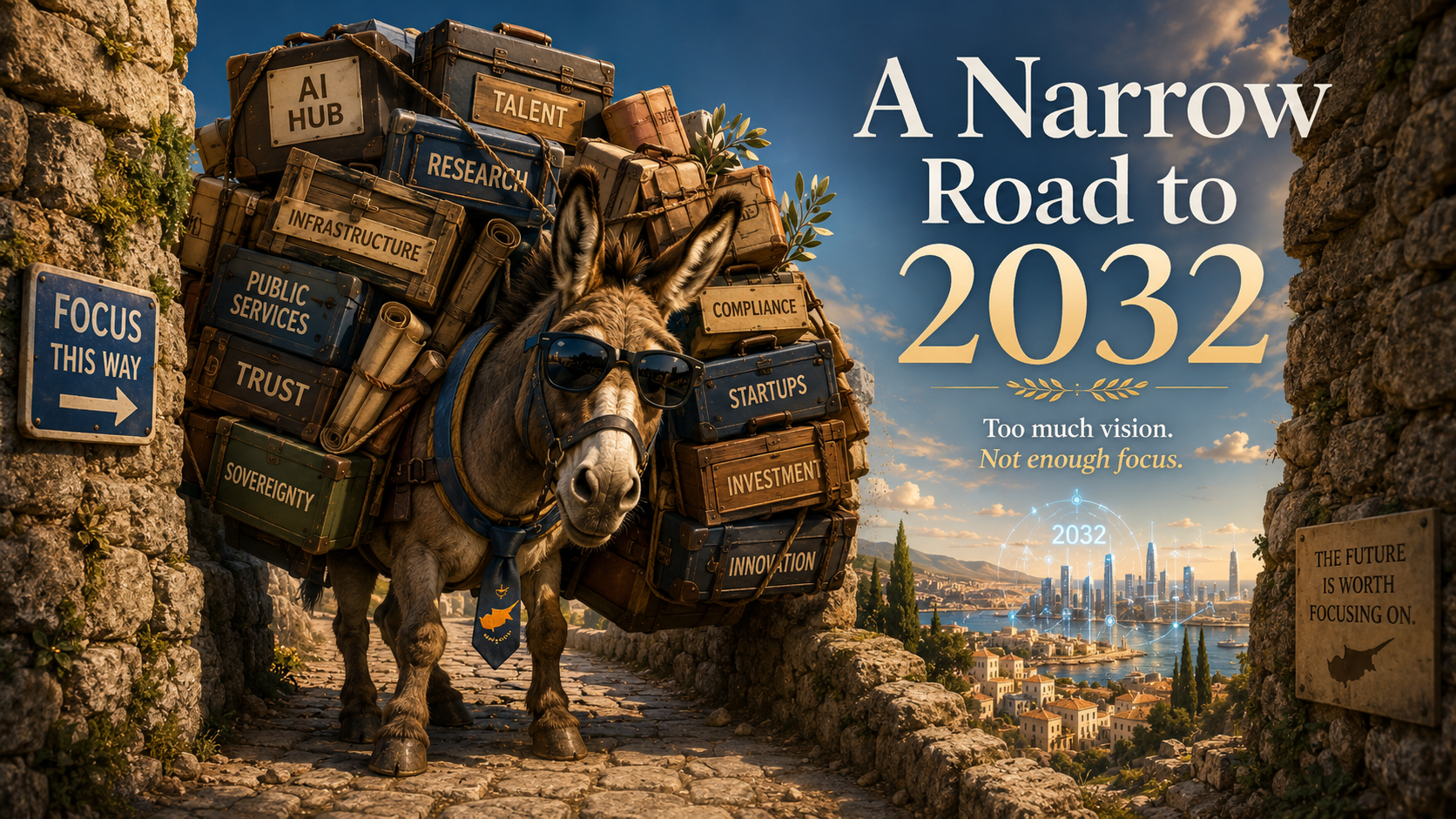
But a small country cannot prioritise everything equally.
In my opinion, the strategy will become much more convincing if Cyprus concentrates on a limited number of areas where it can genuinely stand out:
1. AI for regulated and professional services.
2. Maritime, energy, water and climate applications.
3. Practical improvements to public administration.
4. AI governance, testing and compliance services.
These are areas where Cyprus either possesses existing expertise or faces a clear national need.
The European Commission still describes AI adoption among Cypriot businesses as low and has specifically recommended translating the strategy rapidly into concrete support measures for companies. By comparison, almost 20% of EU enterprises were already using AI in 2026.
A particularly timely study, published only a few days ago, reaches a similar conclusion. In AI-Related Technological Capability and Economic Growth in Cyprus: Exploratory Macroeconomic Evidence, Constantinos Challoumis and his co-authors examine whether Cyprus is successfully converting its technological capabilities into economic value. Their central finding is not that Cyprus lacks digital foundations. ICT specialists already account for 5.4% of employment, slightly above the EU average. The more obvious weakness is what the authors describe as the gap between enabling conditions and realised adoption: Cyprus appears to possess people, connectivity and digital capabilities that are not yet translating into widespread organisational use of AI.
This distinction matters because adopting AI is not the same as buying access to an AI tool. The study argues that Cyprus needs more practical support for SME experimentation, stronger links between businesses and research institutions, better access to data and cloud infrastructure, and training that includes managers as well as technical staff. These conclusions reinforce my own view that the success of the 2032 strategy will depend less on producing more general awareness and more on helping organisations redesign actual processes, develop internal capabilities and move successful experiments into everyday operations.
The final strategy should therefore make clear who is responsible for each action, how it will be funded and how progress will be measured.
For example, “supporting business adoption” could mean many things. A serious programme would specify how many companies will receive technical assistance, how projects will be selected and what measurable outcomes are expected.
Similarly, “developing AI talent” should eventually translate into numbers: graduates trained, specialists recruited, researchers retained and public servants educated.
I do not see this as criticism for the sake of criticism. On the contrary, clear ownership and measurement are what will protect a promising strategy from gradually disappearing from public attention.
Sovereignty Without the Flag-Waving
There is also much discussion in the strategy about sovereign AI.
The phrase creates an appealing image: Cypriot data, Cypriot infrastructure and perhaps even a Cypriot large language model answering questions in Greek while running from a government-owned data centre.
In my opinion, that is the wrong test.
Cyprus does not need to manufacture its own chips or build a national alternative to ChatGPT. It needs to know where sensitive data are stored, understand how important systems make decisions, avoid becoming permanently trapped with one supplier, and retain the ability to audit or replace the technology it buys.
Sovereignty is not owning every component.
It is being able to change direction when one component fails.
For a small country, that may be the more valuable form of independence.
The Test of 2032
Imagine Cyprus in 2032. Go to: www.cyprus2032.ai (I've already bought this url btw)
A shipping company in Limassol is exporting an AI system that reduces fuel use. A regulatory firm in Nicosia is helping overseas companies demonstrate compliance with the EU AI Act. A civil servant processes an application in two days instead of two months because AI handles the paperwork while a person remains responsible for the decision.
None of these examples would make Cyprus the next Silicon Valley.
Together, however, they would make it something more credible: a place where AI is applied to real problems, in industries we understand, under rules people can trust.
That is why I am broadly positive about the AI Vision 2032.
Not because every ambition will necessarily be achieved, and not because adding the letters “AI” guarantees transformation. I am positive because Cyprus has several plausible advantages: a compact economy, internationally connected service sectors, strong professional expertise and the ability—at least in principle—to coordinate more quickly than much larger countries.
The challenge is focus.
Cyprus does not need to enter every race. It needs to select a small number in which being small, specialised and European is an advantage.
In my opinion, those races are professional and regulated services, shipping, selected public services, and AI assurance.
The vision gives us the destination.
What matters now is whether we choose a sufficiently narrow road to get there.